
As I turn the corner, the stoplight ahead poses a challenge. Will I make it before the light changes? It’s only one block, but it’s also a major intersection. I’ve already used more thought to describe the situation than I did as I pressed my foot to the accelerator and sped up to and through the light just as it turned yellow.
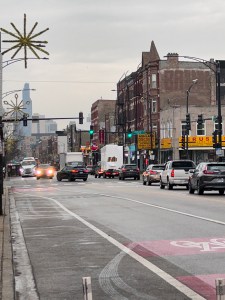
Everyday Probability Problem:
Will I make the light?
The decision wasn’t very conscious, and I certainly had no time to calculate anything.
Or did I? This little exercise in evaluating the odds repeats itself all day long. The problem may not be the traffic light, but think of how many little decision points happen in the course of your day. Our habits obscure the decision points, the actions now impulse driven not deliberate. In those moments our time and energy are spared, our attention reserved for whatever comes up next, or for more important and energy intensive needs like stepping up our evaluation into analysis and actually calculating risk and or opportunity.
I remember reading a newspaper article about problem solving, that referenced the Monty Hall problem. When I was a kid we loved watching the Price is Right. Monty Hall, as host would go into the audience to pick contestants. It was a popular show, and lots of people would dress up in crazy outfits with signs to get his attention. They hoped to stand out and thus increase their chance of being chosen. Isn’t that what we do? we think that in a random world we can do something to draw someone’s interest.
Randomness doesn’t work that way. Monty Hall understood randomness. Once a contestant was picked to play the game, Monty would direct everyone’s attention to the three curtained off sections on the stage. He would describe what was the big prize, and ask if the contestant wanted Door # 1, Door # 2 or Door #3? So what’s the problem? No matter what door the contestant picked, Monty would then reveal what was behind a door they Hadn’t picked. He would offer them some amount of money to change their pick.
My brothers and I loved watching the show. We liked seeing the crazy outfits of the contestants and we loved the dramatic tension that Monty always created. Was the price of taking the cash better than risking whether your pick was the door with the prize? The possibility of winning the prize was what captivated me, not the evaluation of the odds.
I know that every time probability was a topic in my math classes, I struggled and generally failed the lesson. That pattern continued into graduate school. Which turned out to be pretty embarassing as my uncle taught statistics and was well respected for his work in Probability. Fortunately, I had a professor who turned my failure into triumph. I’m not saying I am more successful because of my understanding of probability, but it certainly helps me notice when people are ignoring the principles.
Knowing that sometimes the results you get are random and knowing when results are part of a trend is helpful in making decisions and taking risk associated with knowing you might be wrong.
In my case of the stop light? was it worth speeding up without exceeding the speed limit and make it through the light? Absolutely as it bought me the extra few minutes I saved not stuck waiting for the light to change. Then again, the few minutes I gained were lost at the next light I missed.
Some bets take more consideration and cause more aggravation. The possibility requires you to take on some risk. An experienced professional can help you calculate and advise of the probability your possibility can be realized in a time frame you imagine.
When it comes to the important choices you are making, Who is your advisor?
 FrameStretching