
You know what the big tomato said to the little tomato, don’t you? Catch-up ( as in ketchup).
The joke alludes to the absurdity that we liken life to a race, in which the goals are unstated, ambiguous; without any referee, and a finish line that is mysteriously hidden winning is anything but certain.
I believe the same sensibilities that compel us to keep up also let us know when we are falling behind.l
This little joke and the big tomato figure could be an archetype, a euphemism for the adult, larger than life characters, we look up to when we are “young.” Not only do we believe their example is linked to our future, their actions and words also shape our expectations for our own lives.
The shape, direction or location of this longer, infinite game may not be clear . The rules and guidelines that we use to frame finite games also apply but somehow we often suspend them in the actual play of the infinite. It’s in playing and contrasting the finite and the infininite that we begin to understand ourselves and our efforts, sense of possibility and relative opportunities that await.
But does it teach us HOW to keep up?
On one hand, in acknowledging the infinite we free up our imagination and test invisible, cultural boundaries, and notions of what’s acceptable, what defines success, and what’s possible for us.
If we are fortunate, an inner dialogue helps us connect, adjust and modulate our energy, efforts and literally will to power up and down our intensity to sustain us over a time horizon of our choosing.
Then again, our direct experience of playing with uncertainty can give us a clearer picture and edge.
Making calculated bets
The advantage of learning to calculate risks as opposed to playing along can prove invaluable.
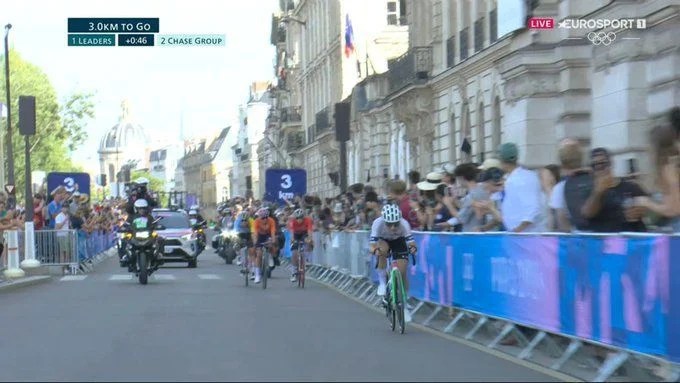
The athletes competing this year in the Paris Olympics offer a series of examples. I’m partial to the story of the American woman cyclist—Kristen Faulkner. Cycline Weekly told her story this way:
…she first began a career in venture capital, tasked with picking the right companies to invest in. “They were quite high risk,” she says, but she quickly learned to analyse them, calculate them, and figure out which ones were worth taking. …”This [race] was a great example today. There was a lot of reward ratio I had to assess during the race. I had to be patient, I had to know when to be aggressive, be able to be patient in the right moments and pull back, and then know when to go all in,” she says.
But it was the quote in the Wall Street Journal that caught my attention.
“ A lot of what I learned to do is how to take calculated risks, how to assess risk,” Faulkner explains. “If there’s high risk, but the reward is high, it might be worth it…what is the risk-reward of being patient versus being aggressive? That’s something I definitely take with me.”
Keeping Pace also builds incremental capacity
Sure, Faulkner trained to be able to modulate her effort she was continuously mindful of the risks and reward ratios. . The pace set in her training kept increasing incrementally. It was that experience of knowing she had more to give that helped propel her in the moment that she wanted to push it.
Consistency may feel like a baseline but it’s always edging up too. There’s clear complicity between pacing ourselves after a push to keep up that gives us the extra capacity and will to push and take the win when the opportunity appears.
If you need to deliver you’re “A” game, avoid burn out. Instead strive for maintaining endurance pace, routinely assess risks and rewards .
 FrameStretching